Peptide profiler
Quick adme quote
Connect with us

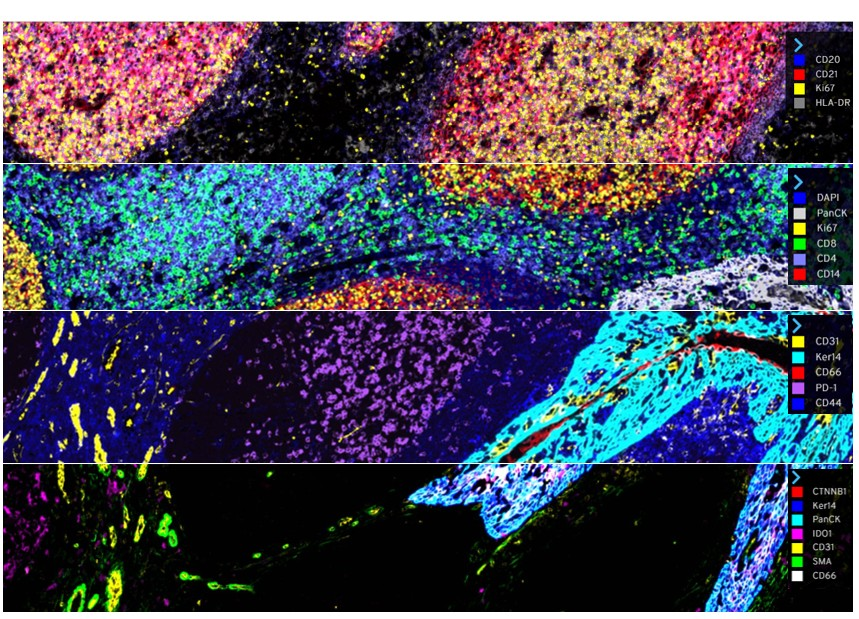
Disease biology is complex. Multiple genes, proteins, pathways and cell types can contribute to the same disease process and a targeted approach may only reveal a small part of the picture.
Spatial omics can reveal where molecular changes occur within tissue, helping you uncover disease biology, identify potential targets and biomarkers, investigate mechanisms of action and understand patient heterogeneity. By mapping molecular information back to the tissue, you can identify the cells and regions driving disease, understand interactions within the tissue microenvironment and uncover novel biology that more targeted approaches may overlook.
When spatial biology expertise, technology access or bioinformatics capacity is limited, it can be challenging to know which approach will generate meaningful insight from often precious samples. At Concept Life Sciences, we work with you to define the right spatial strategy for your project, by aligning the technology to your biological question and interpret the results.
Are you a small biotech looking to access specialist spatial omics capability without building it in-house? Or a large pharmaceutical organization looking for specialist expertise, flexible capacity or translational insight? We tailor our approach to your program.
When disease involves multiple biological processes, focusing on a small number of genes, proteins or cell populations can limit what you discover.
Spatial omics provides a more unbiased discovery approach, allowing you to investigate a broader range of molecular features while retaining their location within tissue. This can help you discover new genes, proteins, pathways and cell types driving disease, or understand how your drug is affecting the tissue, while ensuring findings are linked to the disease site.
The challenge isn't generating more data. It's uncovering the biology you didn't know to look for.
New disease biology: Identify genes, proteins, pathways and cell types associated with disease.
Novel targets: Uncover previously unidentified biological drivers that could support new therapeutic strategies.
Mechanism of action: Understand how your drug affects different cells and regions within tissue.
Biomarkers: Identify molecular and spatial signatures associated with disease or treatment response.
Patient heterogeneity: Investigate why some patients respond while others do not, supporting patient stratification and selection.
What is changing, which cells are involved, and where is it happening? Different omic approaches answer differnet questions, and spatial omics adds the context.
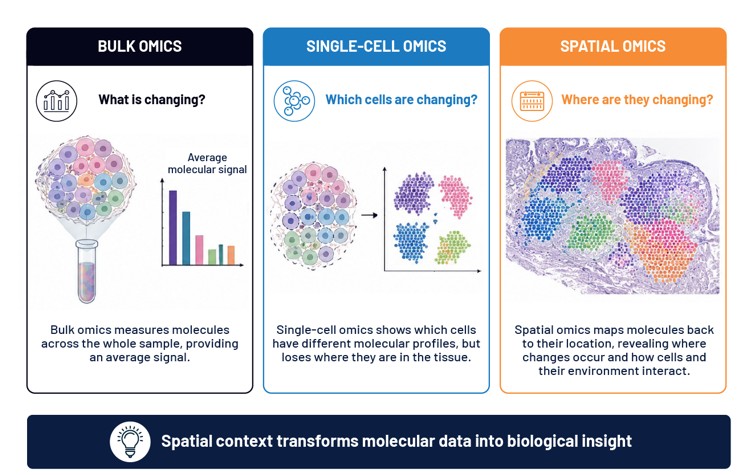
Spatial omics retains the location of molecular information within tissue, allowing molecular changes to be interpreted alongside tissue architecture and cellular neighborhoods.
The result is a broader view of your biology without losing the spatial context that can explain it.
There is no single spatial technology that is right for every project and spatial omics may not always be the only or best approach.
The right strategy depends on what you need to understand, the biology that you are investigating, the sample available, the molecules or biomarkers of interest, the resolution required and the decision the data needs to support. We advise and help you navigate the evolving spatial omics landscape, identify the most appropriate approach and coordinate the right expertise around your scientific objective.
We help you determine:
The objective isn't to generate the biggest dataset. It's to generate the right data to answer your question.
How do you keep pace with a rapidly evolving technology landscape?
Spatial technologies are evolving rapidly. For many organizations, building every capability internally isn't practical, particularly when specialist expertise, technology access and bioinformatics capacity are needed for a specific research question.
Our specialist partner network gives you access to evolving spatial omics technologies and expertise, while Concept Life Sciences provides the scientific direction, project design, project management and biological interpretation.
Result: You get access to the technology you need, without having to build the entire capability around it.
Generating spatial data is only the beginning. Spatial datasets can be extensive and difficult to interpret without the right scientific and bioinformatics expertise. We don't just deliver the data. We help you design the study, interpret the results and determine what to do next.
Through our collaboration with Fios Genomics, alongside our specialist scientific expertise, we can support study design and analysis, helping identify meaningful spatial patterns, molecular signatures, cell populations and tissue regions within complex datasets. Our role is to connect the technology and the analysis back to your biological question.
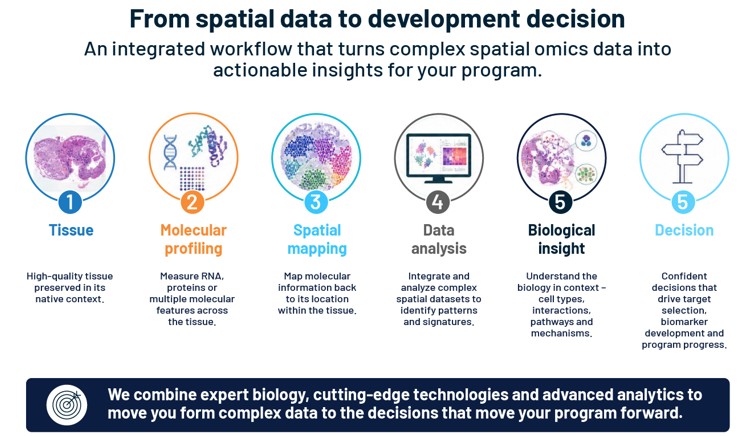
One scientific partner connecting technology, biology and interpretation.
Our value isn't simply in generating a spatial dataset, it's in understanding what that dataset means for your program. Whether it's discovering new disease biology, validating a target, investigating mechanism of action, identifying biomarkers or assessing therapeutic response, we keep the analysis focused on the decision you need to make.
Spatial omics can be particularly valuable when you don't yet know exactly what you should be looking for. Once a target, mechanism or biomarker has been identified, you may not need to continue using a broad discovery approach across every sample.
We can help translate spatial findings into more targeted approaches for larger sample numbers, supporting a practical progression from broad, unbiased discovery to focused validation and scalable analysis.
Discover the biology first. Then apply it at scale.
Spatial omics can add value at different points in the drug development journey, but it can be particularly powerful at two key stages: early discovery and later-stage clinical research.
When you don't yet know which genes, proteins, pathways or cell types are driving disease, spatial omics can provide a broader, unbiased discovery approach. Rather than starting with a predefined target or biomarker panel, you can investigate a wider range of molecular features while retaining their spatial context. This can help identify new disease biology, potential therapeutic targets and mechanisms for further investigation.
Further along the development journey, spatial omics can help investigate why some patients respond to treatment while others do not. Mapping molecular changes within tissue can reveal spatial signatures associated with response, resistance or distinct disease states, helping identify potential biomarkers for patient stratification.
Spatial omics doesn't need to be the endpoint. Once a target or mechanism has been identified, more targeted assays can be developed and applied across larger numbers of samples at lower cost. This creates a practical progression from broad, unbiased discovery to focused validation and larger-scale analysis.
Spatial omics helps you discover the biology. Targeted approaches can then help you validate and apply it at scale.
Sample availability can be a significant constraint, particularly when working with valuable preclinical or clinical material.
Spatial omics can provide extensive molecular information while using less sample than alternative approaches, potentially leaving material available for complementary assays.
We consider your sample type, preservation, available tissue, molecular targets and downstream objectives when designing the approach, helping you maximize the information you can obtain from each sample.
Whether you're a small biotech exploring a new therapeutic opportunity or a large pharmaceutical team investigating disease biology or clinical response, spatial omics can help reveal biological relationships that conventional molecular profiling may overlook.
But the value comes from more than the technology.
Concept Life Sciences combines access to specialist spatial technologies with disease biology, molecular expertise, bioinformatics, project design and data interpretation helping you move from a complex biological question to meaningful insight and the next development decision.
More than access to a spatial omics platform
Start with the biology - We don't start with a predetermined platform. We start with your scientific question, then help determine the most appropriate strategy to answer it.
Specialist disease expertise - Spatial data is most valuable when it can be interpreted in biological context. Our specialist translational biology teams bring expertise across disease areas, including neuroscience and immuno-oncology, helping connect spatial findings with disease mechanisms and therapeutic biology.
Integrated omics expertise - Spatial omics is often most powerful when combined with complementary molecular approaches. Concept can connect spatial studies with molecular biology, transcriptomics and proteomics, helping build a broader understanding of your biology.
Data interpretation, not just data generation - Large spatial datasets can be challenging to navigate. Through our collaboration with Fios Genomics and specialist scientific expertise, we can help interpret the data and translate complex findings into meaningful biological insight.
Bespoke project design - We don't just offer bespoke assays. We offer bespoke project designs. Our project management approach allows you to remain as involved as you want, while we adapt the study around your scientific objectives, sample availability and development stage.
A: Spatial omics combines molecular profiling with spatial information, allowing molecules such as RNA and proteins to be measured while retaining their location within tissue. This provides insight into what is changing, where it is changing and which cells or regions are involved.
A: Spatial biology is the broader field of studying biological processes in their spatial context. Spatial omics focuses on large-scale molecular profiling within that context, including approaches such as spatial transcriptomics, spatial proteomics and spatial multi-omics.
A: Bulk RNA sequencing provides an averaged molecular profile across sampled tissue. Spatial omics retains information about where molecular changes occur, helping distinguish regional and cellular differences that may otherwise be masked.
A: Single-cell approaches provide detailed molecular information at the individual-cell level but can lose information about where those cells were located within the original tissue. Spatial omics retains positional information, allowing molecular data to be interpreted alongside tissue architecture and cellular neighborhoods. It can also ensure that the location of the information being captured is in the correct region and not within regions that are not of interest.
A: Spatial omics can help identify new genes, proteins, pathways and cell types driving disease, investigate mechanisms of action, discover biomarkers and understand differences between patient populations.
A: Yes. Spatial omics can help investigate molecular and cellular differences between patient populations, including why some patients respond differently to treatment. This can support the discovery of signatures for patient stratification.
A: Yes. Spatial omics can be particularly valuable as an unbiased discovery tool early in drug development and for investigating patient response and stratification in later-stage clinical research.
A: Yes. Data interpretation is a key part of the workflow. We can support analysis and interpretation of complex spatial datasets through our specialist expertise and collaboration with Fios Genomics.
A: Yes. Spatial omics can be used alongside other molecular approaches. Concept can connect spatial studies with molecular biology, transcriptomics and proteomics to provide complementary biological insight.
A: The appropriate sample type depends on the technology and biological question. Tissue preservation, section quality, sample availability and molecular targets all need to be considered during study design.
A: Yes. Once a target, mechanism or biomarker has been identified, findings from a broader spatial discovery study can inform more targeted approaches designed for larger sample numbers and scalable analysis.

