Peptide profiler
Quick adme quote
Connect with us


Because biochemical screening provides the foundation for successful drug discovery, enabling confident hit identification, lead selection, and progression through your screening cascade. It uses purified enzymes, receptors, or other biomolecules to assess how a compound influences specific biochemical reactions.
We know drug discovery is complex, and early-stage screening can make or break a program.
Our biochemical screening assay services are designed to solve the key challenges teams face. By combining scientific expertise, automation, and integrated drug discovery capabilities, you will receive actionable data that enables you to drive your project forward with confident decisions.
Biochemical screening assays find their value as primary and counter assays and are often the first critical step in your discovery cascade in early drug discovery. They are used in hit identification as a first pass, for screening potential lead compounds due to their:
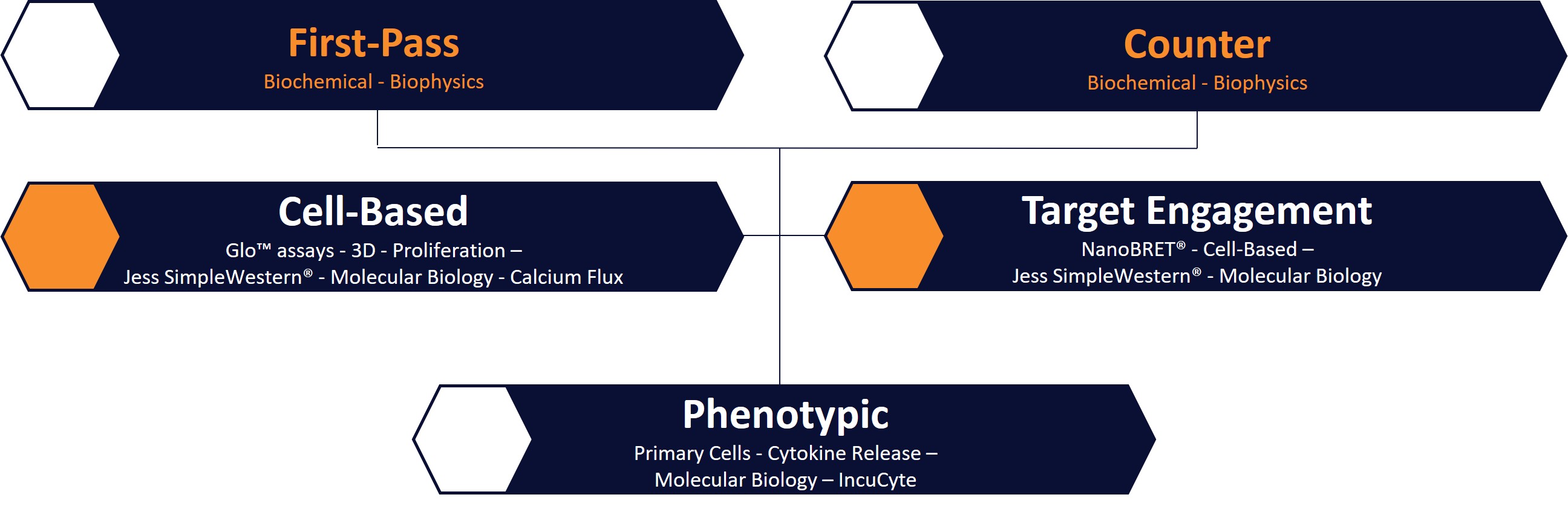
By integrating screening with computational design, medicinal chemistry, ADMET/DMPK, and translational biology, we enable faster, more informed progression from target validation to development-ready candidates. This integrated drug discovery model reduces project risk, shortens development timelines, and improves candidate quality by ensuring that decisions are supported by multi-parameter data.
Drug discovery teams often face critical challenges in biochemical screening. At Concept Life Sciences we engineer solutions to solve your challenges.
Our experienced scientists proactively address risks through rigorous assay optimization, validation, and ongoing performance monitoring, ensuring the generation of reliable, decision-ready data.
By addressing these challenges head-on, we empower your team to focus on discovering molecules with real therapeutic potential, faster and with lower risk.
Our biochemical assays are embedded within a full integrated drug discovery platform, combining:
This means every hit from your screening cascade is evaluated in the context of potency, solubility, lipophilicity, and developability helping you make informed, risk-reduced decisions.
Our platforms are built to match your drug discovery pace:
We know that inconsistent assays waste time and budget. Our team optimizes every parameter, target concentration, buffers, DMSO tolerance, plate type, temperature, and incubation times so your assays perform consistently across the full screening campaign.
This robust foundation supports:
Once hits are identified, by integrating screening data with ADMET and DMPK insights enables us to accelerate your candidates’ progression:
This ensures you advance the right molecules faster, reducing development timelines and risk.
Proven expertise: Multidisciplinary teams with experience across complex targets and assay formats.
Client-focused: We act as an extension of your team, interpreting data and aligning screening strategy to your goals.
Reliable data: Optimized, validated assays with ongoing performance monitoring.
Seamless integration: Biochemical screening embedded in an end-to-end discovery platform.
Scalable solutions: High-value programs delivered efficiently, whether using bespoke assays or commercial kits.
Our biochemical screening services are embedded within our wider integrated drug discovery platform, enabling seamless progression across disciplines:
Together, these services form a connected, end-to-end platform supporting target validation, hit discovery, hit-to-lead, lead optimization, and preclinical development.
Discover how our biochemical screening expertise can support your next discovery program. Contact our team today to discuss your integrated drug discovery project requirements, biochemical screening, and hit-to-lead strategy.
A: We work with you to develop assays for a broad spectrum of targets, including enzymes, GPCRs, ion channels, nuclear receptors, epigenetic proteins, and protein–protein interactions. Whether you need commercial kits or fully customized solutions, we ensure the assay meets your project goals and accelerates decision-making.
A: Our biochemical screening assays are designed to deliver actionable data that directly informs your drug discovery decisions. By integrating screening with ADMET, medicinal chemistry, and cell-based assays, we help you rapidly identify promising hits, optimize leads, and reduce risks, giving you confidence at every stage.
A: We provide flexible, high-throughput platforms such as HTRF, TR-FRET, NanoBRET™, AlphaLISA, FLIPR, GLO assays, rapid Westerns, and Fluorescence Polarization. These technologies are designed to handle large compound libraries efficiently, giving you reliable, fast results that keep your project on schedule.
A: Your project’s success is our priority. We optimize every assay for robustness and reproducibility, use state-of-the-art ELN/LIMS systems for secure data capture, and maintain close collaboration with your team and our internal Chemistry, Biology, and ADMET experts. This ensures you receive high-quality, decision-making data you can trust.


