Hepatocyte And Liver Mode-of-Action Assays

For Regulatory Toxicology

GLP-compliant hepatocyte assays delivering regulator-trusted mechanistic insights

Why do hepatocyte assays often fail to answer the real regulatory question?

When liver findings emerge in non-clinical studies, the challenge is rarely detecting an effect - the question is understanding what it means for human risk.

Many in vitro liver models lack metabolic competence, show non-physiological responses, or fail to distinguish adaptive enzyme induction from adverse toxicity. creating uncertainty, delaying regulatory progress and weakening weight-of-evidence (WoE) arguments.

From hepatocyte data to regulatory decision-making

Our scientists support pharmaceutical, agrochemical, cosmetic, industrial chemical, and specialty chemical industries across discovery, development and registration.

Using primary hepatocytes and liver-relevant systems that preserve key enzymatic, regulatory and adaptive responses, our experts integrate gene expression, enzyme activity, and cellular proliferation, generating a complete mechanistic picture of how chemicals and drugs interact with hepatic pathways.

These GLP-compliant studies give you the clarity needed to make confident decisions and prepare robust submissions to regulators such as ECHA/REACH, EFSA, FDA, and EMA.
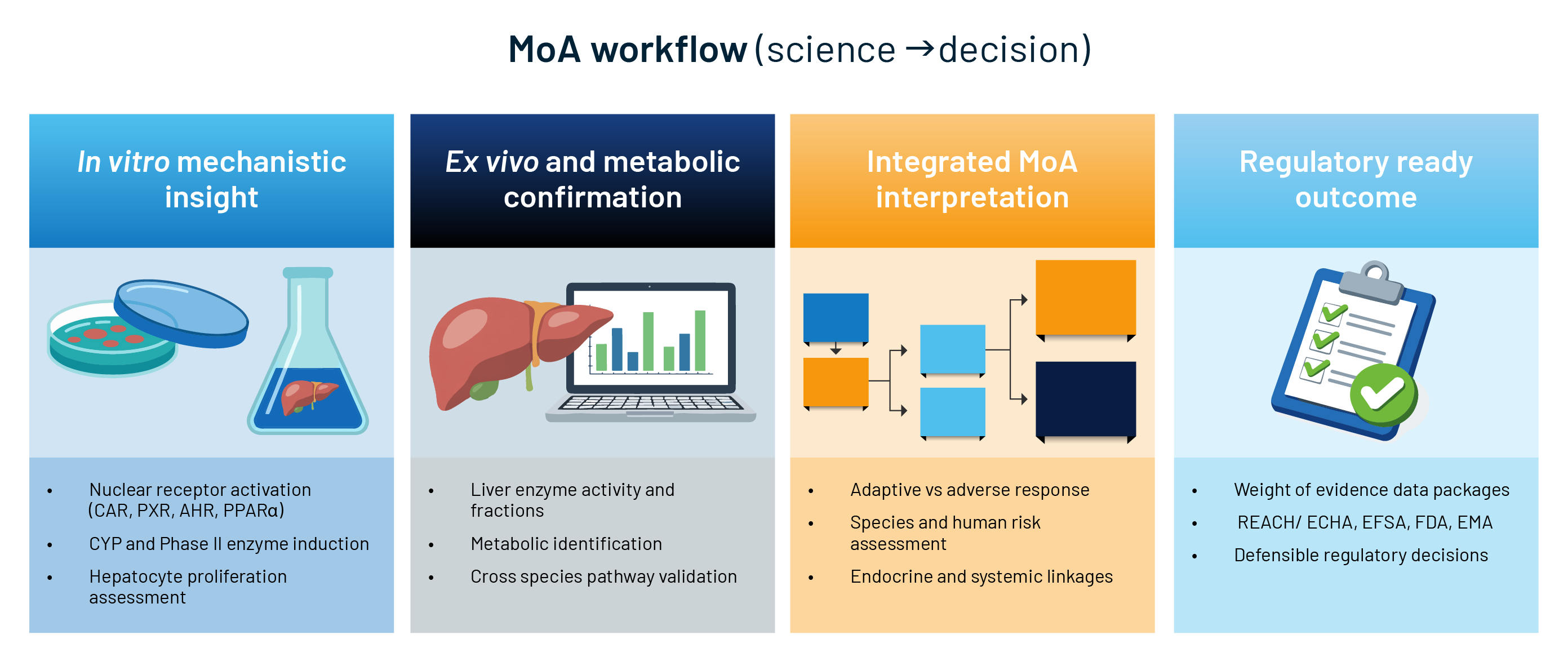
Mechanistic toxicology workflow infographic showing a four-step pathway from in vitro primary hepatocyte studies through ex vivo metabolic confirmation and integrated mode-of-action interpretation to regulatory-ready weight-of-evidence outcomes.

Why hepatic mode-of-action matters

The liver is the primary organ governing xenobiotic metabolism and internal exposure. Chemical-mediated modulation of hepatic pathways including CYP induction, Phase II conjugation, nuclear receptor activation, or altered hormone clearance, can drive toxicity outcomes, influence endocrine effects, and determine species relevance.

From a regulatory perspective, hepatic mode-of-action (MoA) data are critical for:

  • Interpreting in vivo liver findings.
  • Distinguishing adaptive responses from adverse effects.
  • Assessing human relevance and interspecies differences.
  • Supporting weight-of-evidence (WoE) and MoA-based risk assessment under frameworks including REACH, EFSA, ECHA, FDA, EMA, and ICH.

It’s not just about generating descriptive data. Our fast, robust, efficient and cost-effective hepatocyte studies are explicitly structured to help answer your specific regulatory and scientific questions.

Why primary hepatocytes remain the gold standard

Primary hepatocytes preserve Phase I/II enzymes, nuclear receptors, and regulatory pathways, providing:

  • Physiologically relevant enzyme expression and regulation.
  • Human-relevant induction and metabolism profiles.
  • Cross-species comparison (human, rat, mouse, dog).
  • Broad regulatory acceptance for mechanistic and supportive submissions.

This ensures your studies provide actionable insights, strengthen MoA-driven toxicology strategies, and reduce uncertainty in hepatotoxicity and liver-related endocrine evaluations.

Hepatocyte and liver toxicology assays

With over twenty years of experience, our scientists structure hepatocyte studies to focus on your scientific and regulatory questions, not just generating descriptive data.

Efficient, robust, and cost-effective, these studies integrate molecular, functional, and phenotypic endpoints to deliver regulator-ready insight across discovery, development, and registration programs.

What are hepatocyte mechanistic mode-of-action (MoA) studies?

Hepatocyte MoA studies form the backbone of liver mechanistic toxicology, using rodent, dog, and human primary hepatocytes to evaluate how xenobiotics perturb hepatic signaling pathways and whether responses are adaptive or adverse.

These studies integrate three core mechanistic readouts:

  • Gene expression - including nuclear receptor activation (CAR, PXR, AHR, PPARα) and downstream targets including CYP1A, CYP2B, CYP2C, CYP3A, and CYP4.
  • Enzyme activity - functional assessment of CYP and Phase II enzyme activity,linking transcriptional changes to metabolic competence.
  • Hepatocyte proliferation - Evaluation of proliferative responses to distinguish adaptive enzyme induction from adverse liver effects.

This integrated approach delivers mechanistic clarity to support species relevance assessment, regulatory interpretation, and MoA-based decision-making.

What are CYP induction assays used for?

CYP induction assays support pharmaceutical drug–drug interaction (DDI) risk assessment while informing broader liver MoA interpretation.

Using primary human hepatocytes, we offer:

  • Screening CYP induction studies for early decision-making.
  • Regulatory CYP induction studies aligned with FDA, EMA, and ICH guidance using pre-qualified donors.

Induction is assessed via gene expression and LC-MS/MS-based enzyme activity, with results reported as EC₅₀, Emax, and Relative Induction Scores (RIS), generating regulator-ready data for submissions.

CYP induction assay card

Why are Phase II enzyme induction studies (UGT & SULT) important?

Phase II liver enzymes play a central role in thyroid hormone metabolism and clearance, making them critical for endocrine and thyroid MoA interpretation.

Our GLP-compliant in vitro comparative Phase II induction studies use primary human and rat hepatocytes, cultured for up to seven days, to assess:

  • UGT induction, including pathways relevant to T4 glucuronidation.
  • SULT induction, including pathways relevant to T4 sulfation.
  • Integrated effects on thyroid hormone clearance.

Mechanistic readouts include gene expression and enzyme activity, generating robust data packages that bridge liver metabolism with thyroid disruption and support regulatory endocrine assessments.

How do you assess in vitro and ex vivo metabolic stability and metabolite identification?

We characterize how compounds are processed by liver enzymes and identify primary and secondary metabolites to support MoA and safety assessment.

Our approach integrates:

  • In vitro hepatocyte metabolism to assess turnover and clearance.
  • Ex vivo liver tissue and subcellular fraction assays to confirm enzyme activity at the tissue level.

These data strengthen MoA interpretation, support hazard assessment, and inform human relevance and metabolic liability evaluation.

What is the role of hepatocyte proliferation assays?

Hepatocyte proliferation is a key mechanistic endpoint for distinguishing adaptive liver responses from adverse outcomes.

Our assays:

  • Quantify dose-dependent proliferative responses.
  • Integrate with nuclear receptor activation and enzyme induction data.
  • Support MoA and weight-of-evidence arguments in regulatory submissions.

These studies are particularly valuable when interpreting liver hypertrophy, enzyme induction, and potential tumorigenic risk signals.

How is drug-induced liver injury (DILI) assessed?

DILI-focused studies use primary hepatocytes to evaluate hepatotoxic potential and identify early warning signals.

Endpoints include:

  • Cell viability, including ATP content and LDH release.
  • Oxidative stress and mitochondrial dysfunction.
  • Steatosis and fibrosis-related readouts.
  • Integration with enzyme induction and proliferation dat.

These studies support early risk mitigation and informed compound progression for pharmaceuticals, agrochemicals, and other xenobiotics, aligned with regulatory expectations.

What are ex vivo liver enzyme activity assays?

Ex vivo Phase I and Phase II enzyme activity assays are conducted using liver tissue and subcellular fractions. Our GLP-validated ex vivo liver enzyme activity assays are conducted using liver tissues from rodent and fish species to characterize xenobiotic metabolism and hepatic pathway modulation

  • Phase I enzyme activities including EROD, PROD, BROD, BQ, LAH, and PCoA
  • Phase II pathways including T4-UGT, nitrophenol-UGT, and bilirubin-UGT

Complementary hepatic gene expression and hepatocyte proliferation analyses performed directly in liver tissues enable integrated assessment of enzyme induction, metabolic adaptation, and potential adverse liver responses.

Using LC-MS/MS and fluorescence-based readouts, these assays confirm in vitro findings, bridge cellular and tissue-level biology, and strengthen translational relevance and regulatory confidence.

Ex vivo enzyme activity / in vivo–ex vivo

Delivering mechanistic and regulatory confidence

Across all hepatocyte and liver MoA studies, Concept Life Sciences provides:

  • GLP-compliant, regulator-ready data.
  • Integrated Phase I, Phase II, and proliferation endpoints.
  • Mechanistic clarity to support WoE and MoA-based assessments.
  • Support for regulatory decisions across pharmaceuticals, agrochemicals, and specialty chemicals.

Our focus is simple: deliver liver mechanistic data that clearly answers regulatory questions enabling you to make confident, defensible decisions.

Concept Life Sciences - The right choice for your hepatocyte or liver toxicology studies:

Primary hepatocytes as Gold standard: Not cell lines or simplified liver models; widely accepted regulatory-ready data.

Mechanistic depth, not descriptive: Integrated gene expression, enzyme activity, and proliferation endpoints.

GLP-compliant by design: Data formatted for direct regulatory submission.

Cross-species relevance: Human, rat, mouse, and dog hepatocytes under one roof.

Integrated toxicology: Seamless linkage to hepatotoxicity, ADME/DMPK, liver disease biology and endocrine and in vivo ex vivo studies.

Regulatory experience: GLP-compliant, regulator-ready study designs routinely supporting REACH/ECHA, EFSA, FDA and EMA submissions.

Regulatory Support: Drafting OECD summary in regulatory ready format.

Our focus is simple: delivering robust, efficient and cost-effective hepatocyte assays that clearly answer regulatory questions and supports confident, defensible decision-making.

For integrated endocrine and thyroid insights, explore our endocrine and thyroid disruption assays.  For full in vivo context, see our in vivo and ex vivo toxicology studies.