Peptide profiler
Quick adme quote
Connect with us


Targeted Protein Degradation (TPD) is creating new opportunities to drug challenging targets, but PROTACs and molecular glues introduce unique design and optimization challenges that can slow progress. Our multidisciplinary experts combine advanced CADD, Direct-to-Biology (D2B) workflows, medicinal chemistry, biology, and DMPK to accelerate design–make–test cycles, generate actionable data earlier, and help you make confident decisions faster.
Targeted Protein Degradation (TPD) is redefining what is druggable. By harnessing a cell ubiquitin-proteasome system, modalities such as PROTACs (proteolysis targeting chimeras) and molecular glues enable selective removal of disease-causing proteins, including targets that have previously resisted conventional inhibitor approaches.
Unlike conventional small molecule inhibitors that transiently block protein activity, PROTACs and molecular glues drive target protein degradation. This delivers:
At Concept Life Sciences we support your program from early PROTAC design and molecular glue discovery, providing the integrated expertise you need, to translate degradation biology into a viable drug discovery program.

Download the workflow infographic
TPD therapeutic discovery and development presents distinct challenges including unpredictable structure activity relationships, limited cellular exposure, complex synthesis pathways and uncertainty around degradation mechanisms. Our fully integrated workflows are designed to identify and reduce bottlenecks by combining:
Additionally, Direct-to-Biology (D2B) workflows overcome PROTAC and molecular glue-specific challenges, streamlining design–make–test cycles. Our integrated model approach allows you to reduce handoffs and shorten timelines by reducing time to decision ensuring each compound is evaluated not just for degradation but for real drug-like potential.
When a PROTAC program is stalled, the biggest blocker is often speed, too few compounds tested, too slowly, with too little data. Direct to biology (D2B) enables rapid exploration of the chemistry space identifying hits and validating biological activity quickly. Compared to conventional PROTAC synthesis routes, a 10-fold reduction in reaction scale combined with optimized processes, significantly reduce both cost and turnaround time, helping you test more ideas earlier and prioritize the most promising candidates.
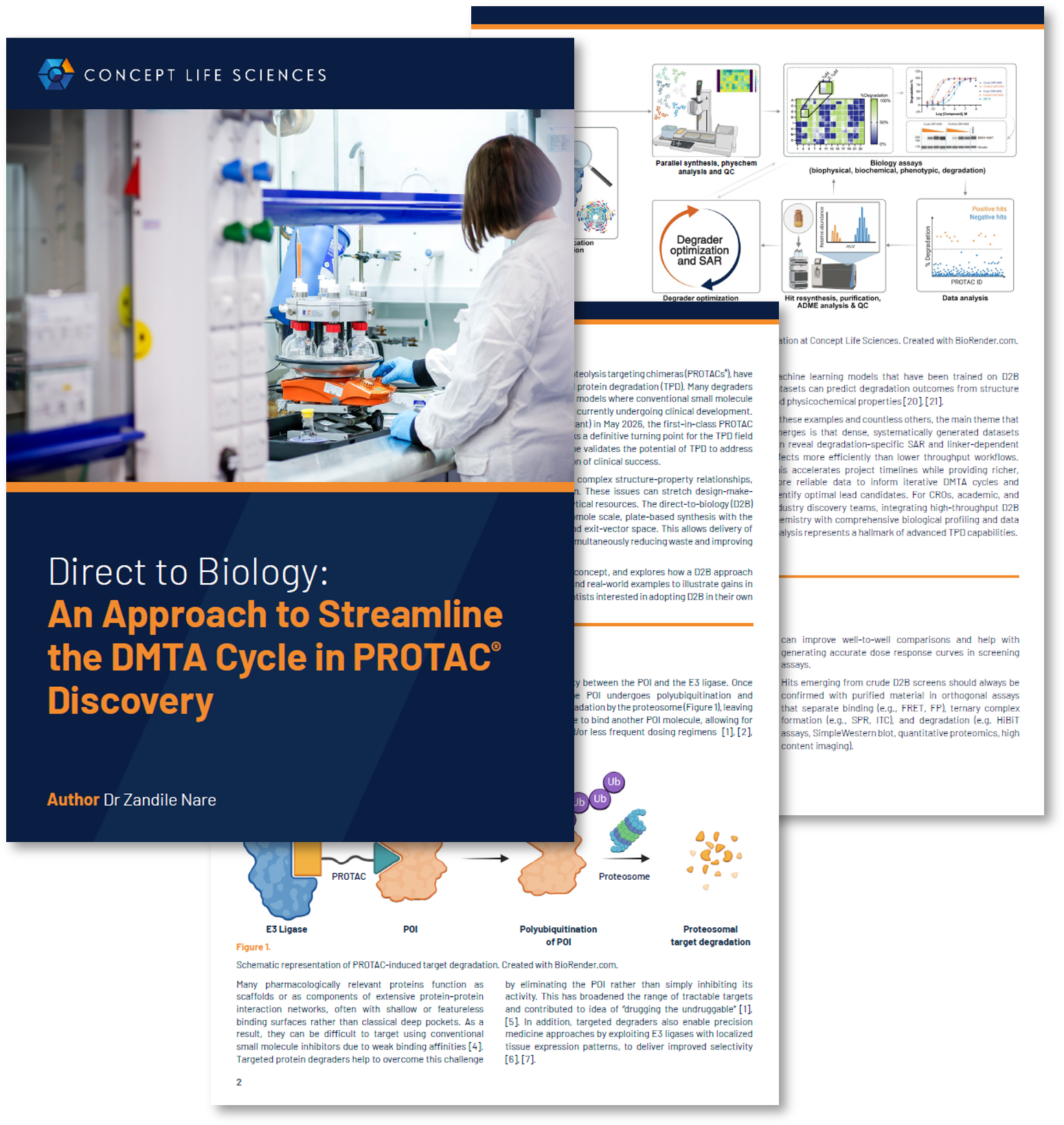
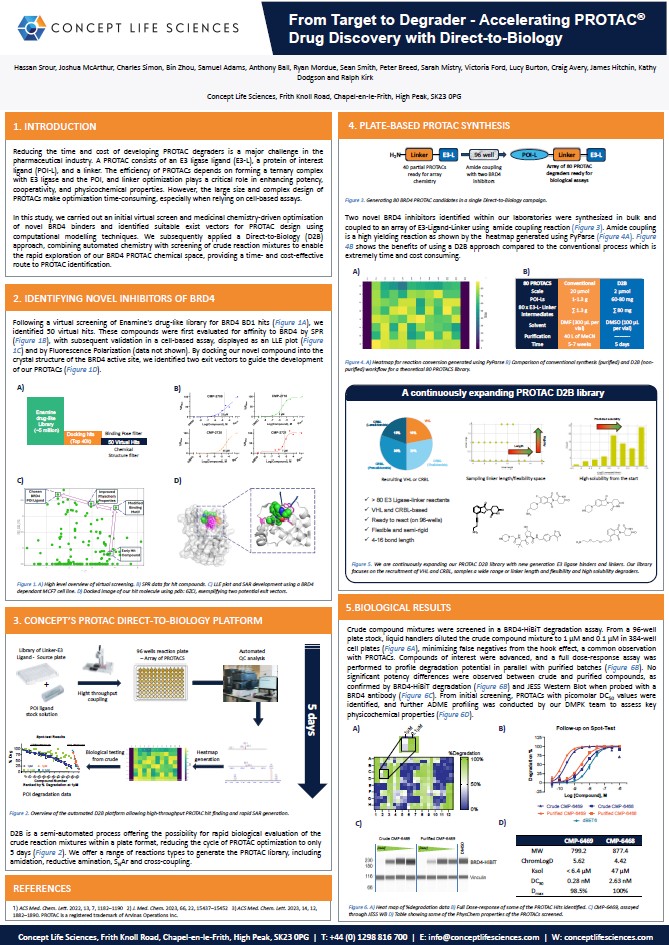
Download the whitepaper to learn more: How a direct-to-biology approach can streamline the DMTA cycle in PROTAC® discovery and view our poster to see how we applied a D2B approach to enable rapid exploration of linker intermediates, providing a time- and cost-effective route to PROTAC optimization.
In TPD, small changes to structure can produce large, unpredictable effects on degradation. This makes trial-and-error optimization expensive and slow. CADD helps navigate this complexity and reduce uncertainty by allowing your program to focus on fewer, better designed, higher-quality PROTACs, accelerating early discovery, with stronger rationale behind each design decision. By combining computational insight with experimental validation, we help you accelerate early discovery while reducing unnecessary synthesis and testing cycles enabling a more predictive and efficient approach to PROTAC discovery.
TPD programs require more than chemistry, they require coordinated biology, mechanistic understanding, and developability awareness from day one.
Our specialist teams understand your unique TPD therapeutic discovery and development challenges. They build sophisticated integrated workflows to directly de-risk decision-making and accelerate your programs progression toward candidate nomination.
Move your program forward with:
A: Targeted protein degradation (TPD) is a therapeutic approach that uses the cell’s ubiquitin–proteasome system to selectively remove disease-causing proteins. Modalities such as PROTACs and molecular glues enable degradation of targets that are difficult or impossible to inhibit with traditional small molecules.
A: PROTAC drug discovery is more complex because it depends on ternary complex formation between the target protein, PROTAC, and an E3 ligase. Small structural changes can significantly impact degradation, making optimization less predictable than traditional small molecule approaches.
A: Yes. Concept Life Sciences provides integrated support from hit identification and design through optimisation, mechanistic profiling, and developability, helping accelerate programs toward candidate selection.
A: D2B enables rapid synthesis and immediate biological testing of compounds, reducing reaction scale by up to 10× and delivering faster insight into functional degradation activity.
Discover how Concept Life Sciences can help you rapidly progress your targeted protein degraded program today. Contact us today for a confidential discussion with our team of expert scientists.