Peptide profiler
Quick adme quote
Connect with us


Fibrosis remains one of the greatest challenges in drug development. Despite promising preclinical results, many anti-fibrotic therapies fail to demonstrate efficacy in the clinic because traditional models often fail to capture the complexity of human disease. Across pulmonary fibrosis, liver fibrosis, kidney fibrosis, dermal fibrosis, endometriosis-associated fibrosis and other chronic fibrotic disorders, disease progression is driven by complex interactions between fibroblasts, epithelial cells, immune cells and the extracellular matrix. Understanding these interactions is critical for identifying effective therapies and reducing development risk.
At Concept Life Sciences, we help drug developers bridge this translational gap through human-relevant in vitro models, advanced immune-stromal co-culture systems, multicellular disease models and spatial biology technologies that generate meaningful, decision-driving data.
Our scientists work as an extension of your team, designing tailored assay strategies that provide mechanistic insight, strengthen candidate selection and support confident progression toward the clinic.
As your scientific partner, we help clients overcome translational challenges in fibrosis drug discovery.
Improve translatability - Build confidence in your therapeutic using human primary cells, tissue-relevant disease models and translationally meaningful endpoints.
Reduce development risk - Generate robust efficacy, potency and mechanism-of-action data that supports smarter go/no-go decisions.
Understand disease complexity - Explore fibroblast activation, immune signaling, epithelial plasticity and extracellular matrix remodeling within physiologically relevant systems.
Accelerate program progression - Work with experienced scientists who design bespoke assays around your biology, modality and therapeutic objectives.
Understanding fibrosis at every level - Choose the right tissue analysis approach to answer your questions.
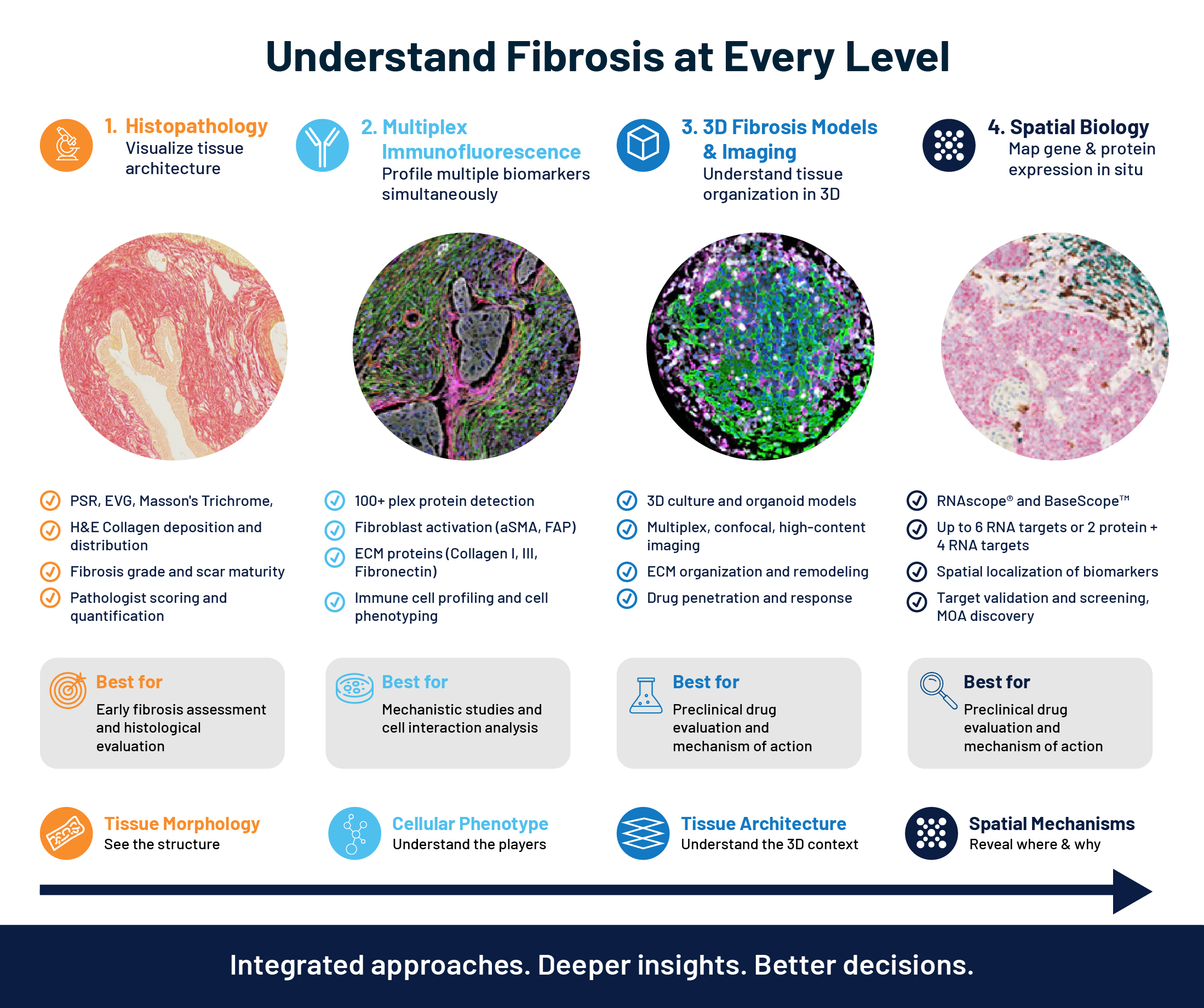
Our fibrosis discovery platforms can be tailored to investigate disease mechanisms and therapeutic responses across a wide range of organ systems.
Although new drug candidates are emerging, a key challenge remains: how can we adapt cell‑based assays to more accurately model tissue‑specific fibrotic mechanisms and overcome the limitations inherent in animal models? Understanding how human immune cells, fibroblasts, epithelial cells and tissue microenvironments respond to treatment provides a more complete picture of therapeutic activity. We offer a suite of high-quality cell-based assays to investigate candidate drugs and our integrated fibrosis platforms combine expertise in:
This enables us to generate deeper mechanistic insights and more predictive data throughout the discovery process.
Many fibrosis pathways cannot be adequately modeled using single-cell systems.
Our multicellular and 3D models recreate key cellular interactions involved in disease progression, allowing more predictive evaluation of candidate therapeutics.
Capabilities include:
Understanding how therapies influence cells within intact tissue architecture provides critical translational insight that conventional assays cannot achieve.
Our Spatial Biology team combines:
to characterize:
These technologies provide a powerful framework for mechanistic interpretation, biomarker discovery and translational decision-making.
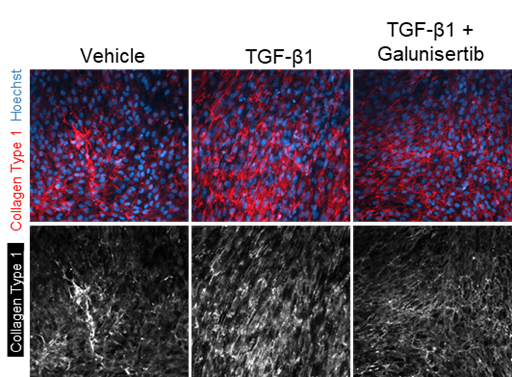
Our multicellular MASH models combine hepatocytes, hepatic stellate cells and macrophages to investigate inflammatory signaling, collagen production and therapeutic responses within a physiologically relevant environment.
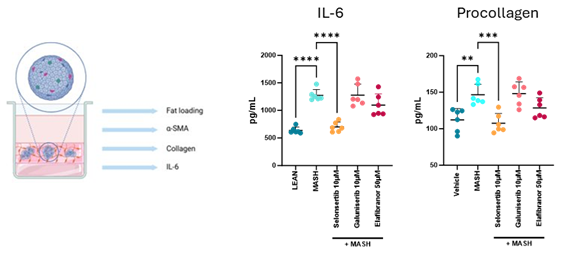
EMT contributes to tissue remodeling and fibrosis across multiple organs. Macrophages are pivotal in modulating EMT and a target for novel therapeutics targeting fibrosis. Our scratch wound assay can be adapted to include macrophages within the epithelial cell culture supporting analysis of functional changes in co-cultures treated with candidate drugs targeting fibrosis.
Our EMT full suite of assays allow you to investigate:
Models can be enhanced through macrophage co-culture to better reflect the inflammatory environment associated with chronic fibrotic disease.
Download the poster: Epithelial to Mesenchymal Transition (EMT) can be driven by macrophages through multiple signaling pathways.
Human-relevant models - Generate data using disease-relevant systems designed around human biology rather than relying solely on traditional animal models.
Mechanism-led science - Move beyond simple activity measurements to understand how your therapeutic works and where it is most likely to succeed.
Integrated expertise - Access specialists across fibrosis biology, immunology, disease modelling, molecular biology and spatial biology through a single scientific partner.
Customized assay development - Every program is different. We design studies around your target, modality, mechanism and development objectives.
Decision-driving data - Our scientists provide clear interpretation and strategic guidance that supports candidate prioritization and reduces development risk.
Our fibrosis expertise is complemented by integrated capabilities across:
Working with a single partner helps reduce complexity, improve continuity and accelerate progression from discovery to clinical development.
Whether you need targeted assay support, translational disease models, spatial biology expertise or an integrated discovery partner, our scientists are ready to help you generate the data needed to move forward with confidence.
Discuss your fibrosis program with our team today.
A: We provide end-to-end fibrosis drug discovery support, from early target validation through lead optimization and translational research. Our capabilities include human primary cell assays, fibroblast and myofibroblast models, immune-stromal co-cultures, high-content imaging, spatial biology, biomarker analysis, and bespoke assay development across multiple fibrotic diseases.
A: We support drug discovery programs across a wide range of fibrotic diseases, including pulmonary fibrosis, interstitial lung disease (ILD), liver fibrosis, metabolic dysfunction-associated steatohepatitis (MASH), kidney fibrosis, dermal fibrosis, pathological scarring, endometriosis-associated fibrosis, and other systemic fibrotic diseases. Our scientists can also develop customized models for specific therapeutic indications.
A: Human-relevant in vitro fibrosis models can provide earlier insight into therapeutic efficacy and mechanism of action while improving translational relevance. By combining primary human cells, multicellular co-culture systems, and disease-relevant endpoints, our assays help generate data that better reflects human biology and supports more informed drug development decisions.
A: Yes. We routinely develop bespoke fibrosis assays tailored to your therapeutic target, biological pathway, modality, and program objectives. Our scientific team works closely with clients to design assays that measure the most relevant cellular, molecular, and functional endpoints needed to answer specific research questions.
A: Our fibrosis assays generate mechanistic and translational data that help identify promising therapeutic candidates earlier in development. By evaluating fibroblast activation, collagen production, immune cell interactions, extracellular matrix remodeling, and tissue-level responses, we provide evidence that supports candidate selection, mechanism validation, and confident progression into later-stage studies.

