Peptide profiler
Quick adme quote
Connect with us


Assay development saves time and budget by ensuring the right experimental approach is implemented early, reducing inefficiencies and re-work later in discovery. At Concept Life Sciences, our PhD qualified scientists design fit-for-purpose biochemical, biophysical, and cell-based assays tailored to specific project goals and discovery phases.
By optimizing assay design, validation, and scalability upfront, we ensure biological relevance, reproducibility, and high data quality, minimizing false positives, inconclusive results, and downstream failures. This robust, targeted approach enables faster decision-making from target screening through mechanism-of-action studies, delivering reliable, actionable data while controlling cost and timelines.
Assay strategies are designed around your biological question, therapeutic modality, and project phase. Our flexible approach based on individual project requirements promotes a collaborative environment to support work on anything from a single custom assay to a fully integrated screening cascade.
Key capabilities include:
We emphasize data quality, reproducibility, and biological relevance so your assays provide real predictive power for your drug discovery efforts.
We follow a transparent, milestone-driven workflow to reduce risk and shorten timelines.
Typical stages include:
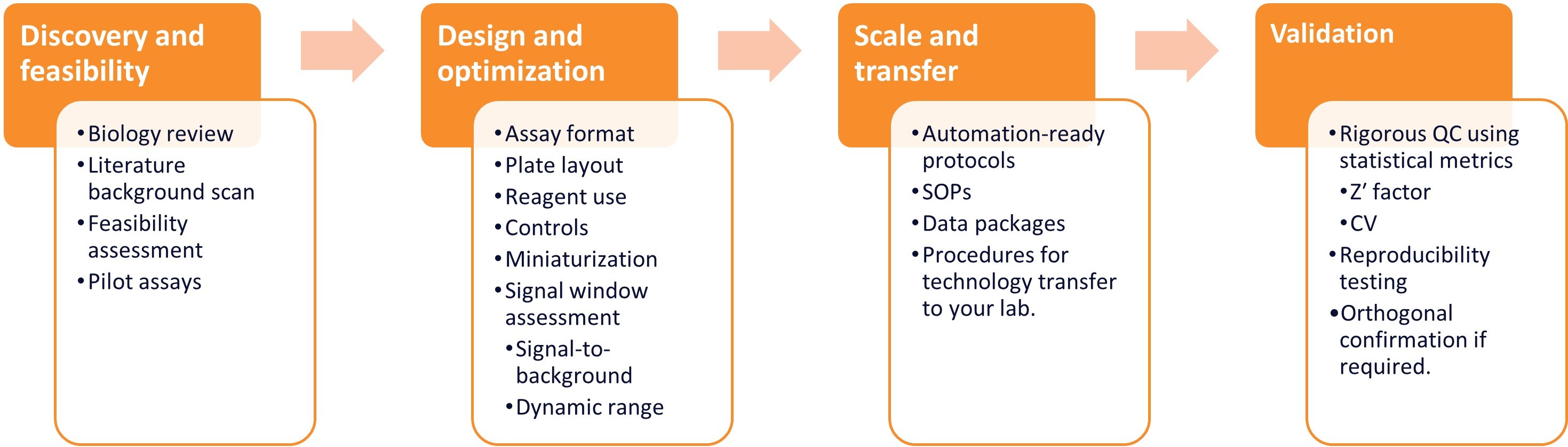
Throughout, we apply a clear decision-framework to obtain the most appropriate selection of biochemical and phenotypic readouts, ensuring the most appropriate, efficient assay path.
Whether this is your only assay or the first step in a full screening cascade, we ensure a smooth path from concept to data you can trust.
Multidisciplinary expertise: Our in-house teams cover biochemical, biophysical and cellular biology, enabling flexible assay design.
Transparent collaboration: You retain control over decision-making, timelines, and data.
Reproducibility-first approach: Validated workflows, stringent QC, statistical rigour and consistent documentation.
Flexibility across modalities: Small molecules, biologics, cell and gene therapies, novel modalities, we adapt to your project’s needs.
Scalable support: From a one-off assay to full screening cascades.
Development of a selective WEE1 inhibitor
Solution: Developed and validated a biochemical kinase assay and delivered SOP, raw data, and automation-ready protocol enabling client to rapidly progress hit-to-lead.
Impact: Reduced single agent cytotoxicity in cancer and non-cancer cell lines.
We deliver assays optimised for each stage of your project:
Each assay is tailored to the biology and decision-points of your program, ensuring data is relevant, robust, and actionable.
A: Biochemical, biophysical and cell-based assays for target validation, screening, and lead optimization.
A: Yes. We design bespoke assays when biology demands it and offer validated ready-to-run assays for common targets.
A: We employ rigorous optimization and validation — including statistical metrics (Z′, signal-to-background, CV) and, where appropriate, orthogonal confirmation prior to scale-up.
A: Low, medium, and high-throughput formats, including automation-ready workflows for screening campaigns.
A: Absolutely. Our multidisciplinary team works with small molecules, biologics, cell and gene therapies, PROTACs, and other emerging modalities, adapting assay design to suit project requirements.
A: Depending on complexity, 4–12 weeks. Timelines are provided with a bespoke development plan and regular progress updates.
A: Yes. We can support primary screening, downstream confirmation, orthogonal assays, SAR cascades, and lead optimization.


