Peptide profiler
Quick adme quote
Connect with us


New Approach Methodologies (NAMs) are transforming the future of drug development. Regulatory agencies, including the European Medicines Agency (EMA) and the U.S. Food and Drug Administration (FDA) are actively encouraging their adoption during the early preclinical phase of drug development. The Goal: Better prediction of human safety and efficacy, whilst reducing reliance on traditional animal models. These shifts are creating new opportunities for scientists to de-risk programs earlier and more effectively.
Recent FDA announcements, draft guidance and NIH investment signal an accelerating shift toward integrated, human-relevant evidence that combines advanced in vitro systems, computational modeling and AI-enabled approaches.
At Concept Life Sciences, we help biopharmaceutical companies build integrated NAMs strategies that generate decision-ready data across discovery and preclinical development. Our team combines translational biology, advanced disease models, biomarker science, toxicology, bioanalysis, computational approaches and regulatory expertise into a single scientific strategy.
Traditional drug development can suffer from poor translation between animal models and human biology. NAMs help overcome these limitations by generating data that is:
The objective is not simply replacing animal studies. It’s enabling you to make better scientific decisions earlier.
Recent FDA initiatives represent one of the biggest changes to preclinical drug development in decades. These include:
For developers, this creates an opportunity to generate more predictive evidence while potentially reducing development timelines, costs and late-stage risk.
Many organizations still think of NAMs as simply replacing animal studies with cell-based assays. The future is considerably broader. Modern NAMs integrate multiple evidence streams including:
One of the fastest-growing areas of regulatory interest is the application of computational science alongside laboratory based NAMs.
Recent FDA communications highlight the importance of computational modeling and AI-supported approaches as complementary evidence for nonclinical decision making. These approaches can strengthen the overall weight of evidence when combined with experimental data. Concept Life Sciences supports computationally informed drug discovery through:
Rather than replacing laboratory studies, computational approaches help optimize experimental design, prioritize candidates and generate stronger mechanistic evidence.
Many CROs now promote NAMs, but few can integrate every component required for a successful regulatory strategy.
Unlike providers that focus primarily on toxicology or individual technologies, Concept Life Sciences brings together expertise across biology, chemistry, ADME/DMPK, toxicology, bioanalysis and CMC to support programs from concept through to clinic.
We support NAMs across:
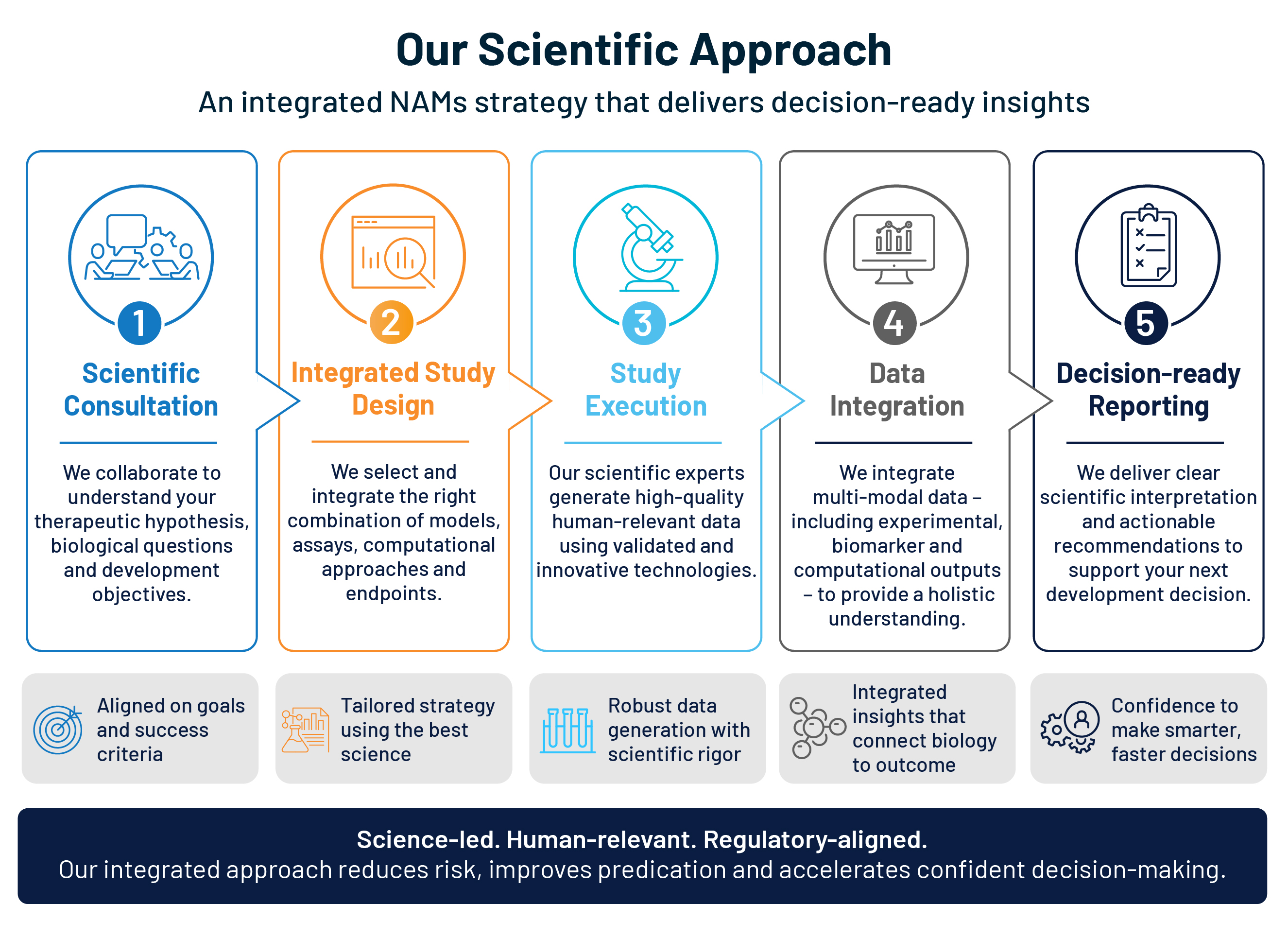
NAMs and Regulatory Shifts Driving Safer, More Predictive Therapeutic Outcomes
The Future of Safer, More Predictive Drug Development – Insights on NAMs
The Medicine Maker - Why the Future of Drug Development Must Be Human
A: NAMs are human-relevant scientific methods that combine advanced in vitro models, computational approaches, organoids, biomarkers and translational biology to improve prediction of drug safety and efficacy.
A: Not entirely. Regulatory agencies increasingly encourage scientifically justified alternatives where appropriate, often using integrated evidence from multiple NAMs technologies alongside traditional approaches.
A: The FDA has released draft guidance encouraging greater use of scientifically validated alternatives to animal testing and is investing alongside NIH in advancing human-relevant technologies, computational models and AI-enabled approaches.
A: In silico methods use computer modeling, AI and computational biology to predict drug behavior, optimize candidates and support regulatory decision making.
CADD uses molecular modeling, structural biology and computational chemistry to identify and optimize drug candidates before laboratory testing, helping reduce development time and improve candidate selection.
A: Yes. We work with clients to combine translational biology, advanced in vitro models, biomarkers, toxicology, ADME/DMPK, bioinformatics and computational approaches into a tailored program aligned with scientific and regulatory objectives.

