Peptide profiler
Quick adme quote
Connect with us


Expert Knowledge



Endocrine (ED) and thyroid disruption (TD) have moved from a niche scientific curiosity to a central pillar of chemical safety assessment. Across global regulatory frameworks, the expectation has shifted: it is no longer sufficient to observe an effect; companies must explain it biologically and mechanistically (Bergman et al., 2013; EFSA, 2018). Early mechanistic insight ensures that observed biological signals are contextualized, relevant and defensible thus supporting hazard classification, risk assessment and regulatory submissions (Doerr et al., 2024).
Mechanistic toxicology bridges this gap between observed effects and regulatory interpretation and providing clarity for hazard classification, risk assessment and submission confidence.
Endocrine and thyroid disruption are no longer peripheral. Across global frameworks, expectations have shifted decisively, from identifying effects to explaining them (EFSA, 2018; OECD, 2018). Internationally, endocrine disruption is recognized as a global concern, with harmonized guidance, tiered testing strategies, and coordinated monitoring initiatives supporting the early identification and prioritization of potentially hazardous substances (OECD, 2018; Kassotis et al., 2020). Globally, approaches vary:
Recent developments instigated within the EU regulatory framework reinforce this trend:
CLP centralization: One-substance, one-assessment (OSOA) logic ensures ED conclusions propagate across sectors, limiting reinterpretation (CLP, 2008; ECHA, 2018; ECHA 2024).
PPP and REACH alignment efforts: Mechanistic clarity is critical to anticipate classification, renewal outcomes, and regulatory prioritization (EC 1107/2009; EFSA, 2018).
REACH prioritization and upcoming updates: With ~23,000 registered substances, mechanistic data inform screening and substance evaluation, preventing unnecessary regulatory escalation. ECHA updates are expected soon in 2026 affecting how endocrine disruption is assessed and which substances may require additional data. Companies should anticipate these updates and prepare mechanistic dossiers accordingly.
Key regulatory messages embedded in current guidance:
Mechanistic uncertainty carries real consequences: substances may face classification, delayed renewal and/or additional testing if mechanistic clarity is missing. For regulatory teams, mechanistic toxicology is no longer optional; it is a strategic tool to reduce risk and guide decision-making.
The endocrine and thyroid systems are finely tuned networks of receptors, enzymes, transporters, and feedback loops. Disruption can occur at multiple points, each representing a molecular initiating event (MIE) that experimental assays can target (Bergman et al., 2012; Martiyniuk et al., 2022). Figure-1 provides an integrated overview of endocrine (ER/AR, steroidogenesis) and thyroid pathways (collectively labelled as EATS), showing where chemicals can interfere and the mechanistic rationale for observed outcomes:
Ligand binding - Receptor activation - Gene transcription - Downstream reproductive effects.
Full EATS coverage captures the complete mechanistic spectrum (OECD TG 456, 457, 458; Holbech et al., 2020). Perturbation of steroidogenesis occurs through inhibition of key enzymes (CYP17, CYP19/aromatase, 3β-HSD), affecting testosterone, estradiol, or progesterone synthesis. These pathways integrate with hypothalamic-pituitary-gonadal (HPG) feedback loops, so even a subtle modulation can amplify downstream effects. Mechanistic assays detect these MIEs, providing biologically plausible explanations for observed reproductive or developmental effects.
Thyroid hormones (THs) are essential regulators of metabolism, neurodevelopment and growth. Maintaining their homeostasis is critical for health across all life stages. Disruption of TH signaling, especially during development, can lead to irreversible neurocognitive deficits and metabolic disorders. Environmental chemicals and xenobiotics can interfere with TH biosynthesis, metabolism or clearance, acting at distinct molecular initiating events (MIEs). Traditional in vivo rodent assays have limitations due to interspecies differences in TH physiology (e.g. hormone transport, metabolism, feedback loops). These models also overlook extra-thyroidal mechanisms including hepatic metabolism and peripheral hormone conversion. There is a growing need for human-relevant, mechanism-based in vitro assays aligned with New Approach Methodologies (NAMs) to improve regulatory assessment and reduce animal use. TH-related pathways include hormone synthesis (TPO), transport (TTR), uptake (NIS), metabolism (UGT/DIO) and feedback regulation. Thyroid Molecular Initiating Events (MIEs) provide a mechanistic basis for interpreting modest hormone changes in toxicology studies (Noyes et al. 2019) to allow interpretation of how chemicals alter thyroid homeostasis at multiple levels. TPO inhibition limits T4/T3 synthesis, DIO inhibition prevents peripheral conversion of T4 to T3, NIS inhibition blocks iodide uptake, and alterations in TTR or UGT affect hormone transport and metabolism. Feedback via the hypothalamic-pituitary-thyroid (HPT) axis may compensate, resulting in subtle serum changes, but tissue-level effects may still be significant. Mechanistic assays, therefore, contextualize observed hormonal changes within a biologically plausible framework.
For example, a compound may inhibit TPO without changing circulating thyroid hormones or bind weakly to ER without transcriptional activation. Mechanistic assays therefore provide critical insight for regulatory interpretation.

Mechanistic assays translate biological insight into regulatory evidence, supporting weight-of-evidence conclusions and risk management. They are critical for both in vitro and integrated in vivo / ex vivo strategies (Table 1).
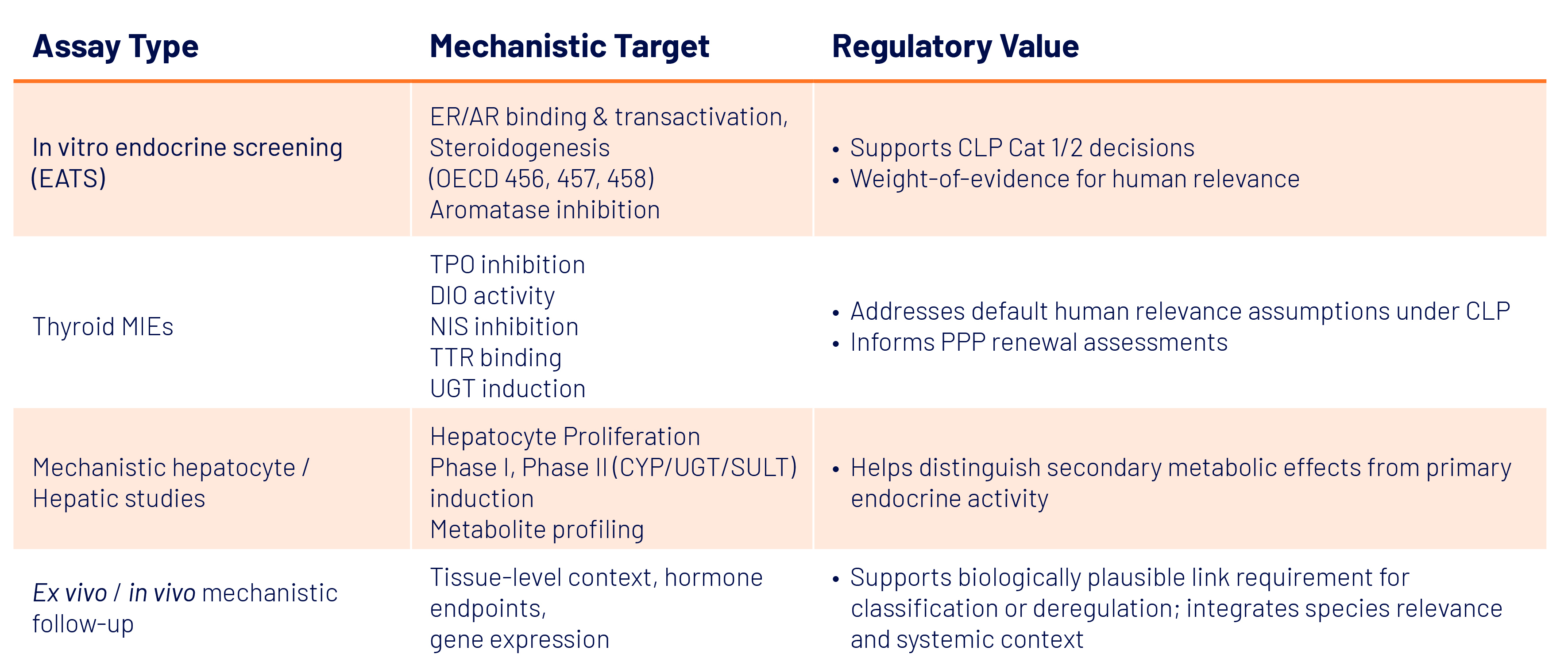
These assays provide defensible mechanistic inputs that regulators expect, enabling more targeted testing, reducing animal use, and strengthening submission robustness.

Mechanistic toxicology supports decision-making across the chemical lifecycle:
Early screening: Identify liabilities, guide structural modifications, refine candidate selection.
Regulatory submissions: Supports endocrine disruptor evaluations, thyroid mode-of-action interpretation, REACH Annex requirements, and EFSA pesticide assessments.
Explaining unexpected findings: Distinguish primary endocrine disruption from secondary metabolic effects, particularly liver-mediated effects.
Reducing regulatory risk: Mechanistic clarity prevents misclassification, unnecessary testing, and submission delays.
Our scientific team helps clients design mechanistic testing strategies aligned with global regulatory expectations. We offer integrated EATS and thyroid assays, in vivo and ex vivo studies, and weight-of-evidence support, producing defensible, regulator-ready data. These top-level solutions reduce ambiguity, anticipate regulatory queries, and guide strategic decision-making.
For more details on services, visit our Endocrine and Thyroid Testing page.
References:
Abbreviations:
AR: Androgen Receptor; CLP: Classification, Labeling and Packaging Regulation; CYP: Cytochrome P450; DIO: Deiodinase; ER: Estrogen Receptor; EAS: Estrogen-Androgen-Steroidogenesis; EATS: Estrogenic-Androgenic-Thyroid-Steroidogenic; ECHA: European Chemicals Agency; EFSA: European Food Safety Authority; HPT: Hypothalamic-Pituitary-Thyroid axis; MIE: Molecular Initiating Event; NAM: New Approach Methodologies; NIS: Sodium Iodide Symporter; OECD: Organization for Economic Cooperation and Development; REACH: Registration, Evaluation, Authorisation and Restriction of Chemicals; SULT: Sulfotransferases; TG: Test Guideline; TH: Thyroid Hormone; TPO: Thyroid peroxidase; TTR: Transthyretin; UGT: Uridine 5'-diphospho-glucuronosyltransferase; WOE: Weight Of Evidence.