Peptide profiler
Quick adme quote
Connect with us


Expert Knowledge

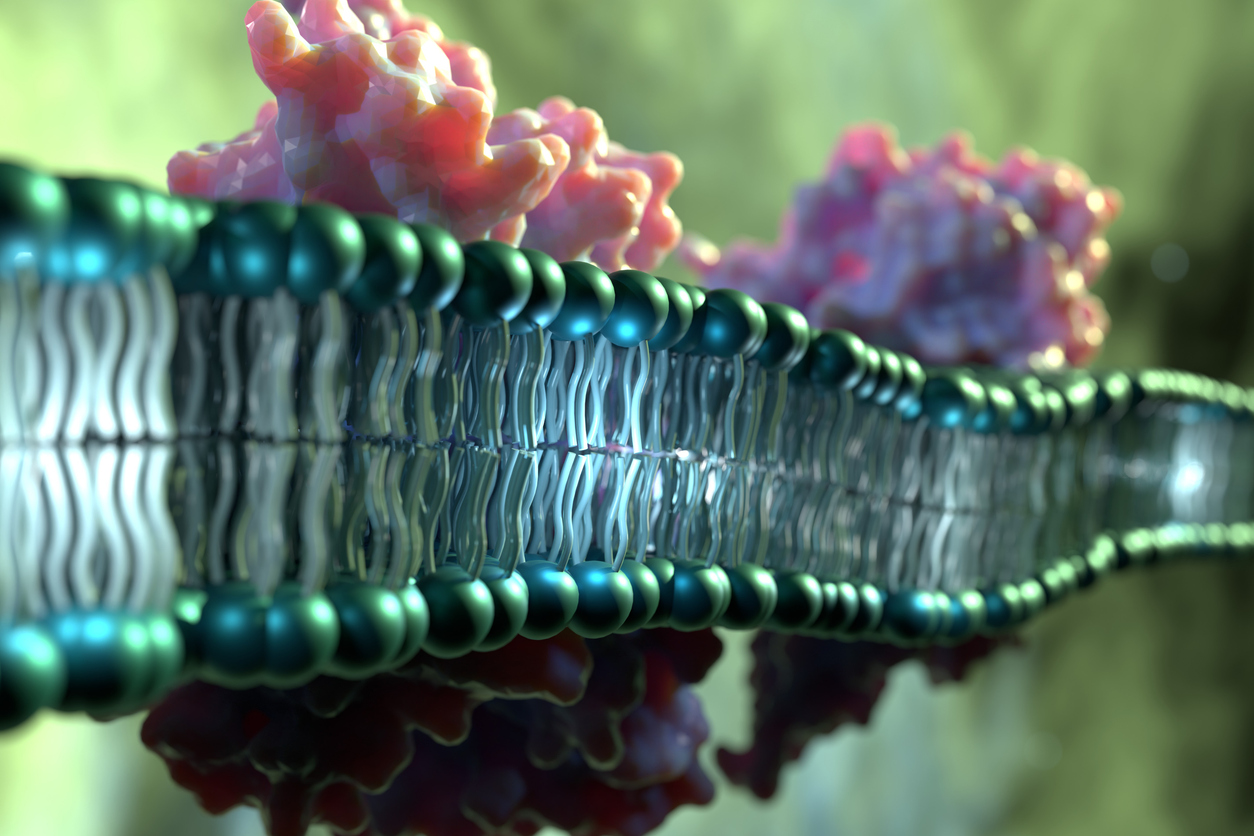
Integral membrane proteins are proteins with at least one part of the polypeptide chain crossing a biological membrane. They are among the most valuable, but also most challenging, targets in drug discovery.
Despite making up only approximately 25% of all proteins in the human genome (2), membrane proteins account for over half of all drug targets (1). Their striking over-representation as drug targets occurs because they sit at the start of many signaling pathways, alongside the fact that they are often present at the cell surface and are therefore easier to access with biologic and small molecule drugs than other targets.
Several features of membrane proteins make unlocking their therapeutic potential anything but straightforward. However, using the right approaches can overcome common challenges.
Since membrane proteins are natively only found in the limited 2D space of membranes, they are much less abundant than soluble proteins. To add to this, each membrane protein may only be expressed in a particular tissue or cell type and in a single sub-cellular membrane.
To overcome this, use of a heterologous expression system such as E. coli (for simple targets), insect cells (for most GPCRs) or mammalian expression systems (for complex targets where correct glycosylation is important) can boost functional expression levels (3). Careful construct design (using in silico methods) and screening of multiple constructs and orthologs where possible can further increase the chances of success.
Membrane proteins have evolved to reside in a phospholipid bilayer, and extraction with detergents often results in protein that unfolds or aggregates, prohibiting its use for downstream processes.
Several approaches can be used to overcome issues with protein stability. Careful selection of a detergent for extraction can help ensure the protein remains folded and active. Design of stabilized constructs and stabilizing point mutants can also result in higher yields and stability. Membrane mimetics (4) such as SMA, amphipols, peptidiscs and nanodiscs are another approach to provide longer term stability in the absence of destabilizing detergents, or a membrane environment can be maintained by reconstitution into liposomes for functional assays.
It may be possible to avoid isolating the process at all. Activity assays, such as membrane transport, can be assessed in overexpressed systems or in relevant cell types, which removes the need for purification and avoids any possible interference from excess membrane mimetic molecules.
Due to low expression and stability, sub-milligram yields purified from multiple litres of proteins is often observed. Obtaining a high purity and activity is also a challenge. Low yields can be overcome by using highly sensitive biophysical techniques such as SPR, GCI (5) and nanoDSF for interaction analysis to minimize protein consumption.
Structural biology is often used to assess the molecular details of protein-protein or protein-small molecule interactions, which allows the rational design of drug molecules using Structure-Based Drug Design (SBDD).
Membrane proteins display inherent flexibility, conformational heterogeneity and long-term instability, which means that the formation of well-ordered crystals for X-ray crystallographic structure determination is particularly challenging.
Design of suitable constructs, careful purification and comprehensive biophysical characterization can increase the chances of structure determination, which can increase the chances of crystallographic success. Using cryo-EM (6) removes the need for ordered crystal formation and allows determination of multiple structures from a single sample, which is particularly useful for large, flexible, full-length membrane proteins and multi-subunit complexes.
Despite the challenges associated with membrane protein characterization, they remain important targets for small molecule and biologic therapeutic development.
Concept Life Sciences have extensive hands-on expertise expressing and purifying these challenging targets in addition to their biophysical and structural characterization. We offer construct design, protein production in bacteria, insect and mammalian systems and purification in detergents and other membrane mimetics. We also offer a suite of QC and biophysical characterization, binding techniques, as well as cryo-EM and crystallographic services.
For more information get in contact today.
References
1. How many drug targets are there? - Nature Reviews Drug Discovery
2. The human proteome in membrane proteome - The Human Protein Atlas
3. Expression of eukaryotic membrane proteins in eukaryotic and prokaryotic hosts - ScienceDirect
4. Recent advances in membrane mimetics for membrane protein research - PMC
5. Kinetic analysis of antibody binding to integral membrane proteins stabilized in SMALPs - ScienceDirect
6. Cryo-electron microscopy analysis of small membrane proteins - ScienceDirect