We connect you with specific subject matter experts to ensure support and recommendations tailored to your project.

Thank you, your request has been received.

We're busy connecting you with an expert, who will be in touch as soon as possible.

Oops! Something went wrong while submitting the form. Please try again or email us at webenquiries@conceptlifesciences.com
We will respond to you within 24 hours of your enquiry being received.

You can also find Concept Life Sciences on the following platforms:

Monocyte Activation Assays

Modulating monocyte activation

Monocytes are key drivers of innate immunity and inflammatory signaling, linking early immune responses to downstream adaptive processes.

Modulating monocyte activation is important across multiple applications, including dampening inflammation in chronic inflammatory diseases or enhancing immune activation in infectious disease and oncology settings.

These assays use human primary immune cells to evaluate how compounds influence monocyte activation and cytokine production across different biological contexts.

Key benefits

  • Modality agnostic: Suitable for both biologics and small molecules.
  • Flexible formats (PBMC and isolated monocytes) enabling context-specific or cell-intrinsic assessment.
  • Robust stimulation (e.g. LPS) to drive reproducible monocyte activation.
  • Multiplex cytokine and phenotypic readouts for comprehensive evaluation of monocyte responses.

Protocol

Compound requirements
Test systems
Assay format
Controls
Quantitation
Deliverables

Data analysis and results

  • Cytokine production (e.g. TNF-α, IL-6, IL-8, IL-1β, IL-12) quantified using ELISA or multiplex platforms.
  • Flow cytometry used to assess activation marker expression on monocytes.
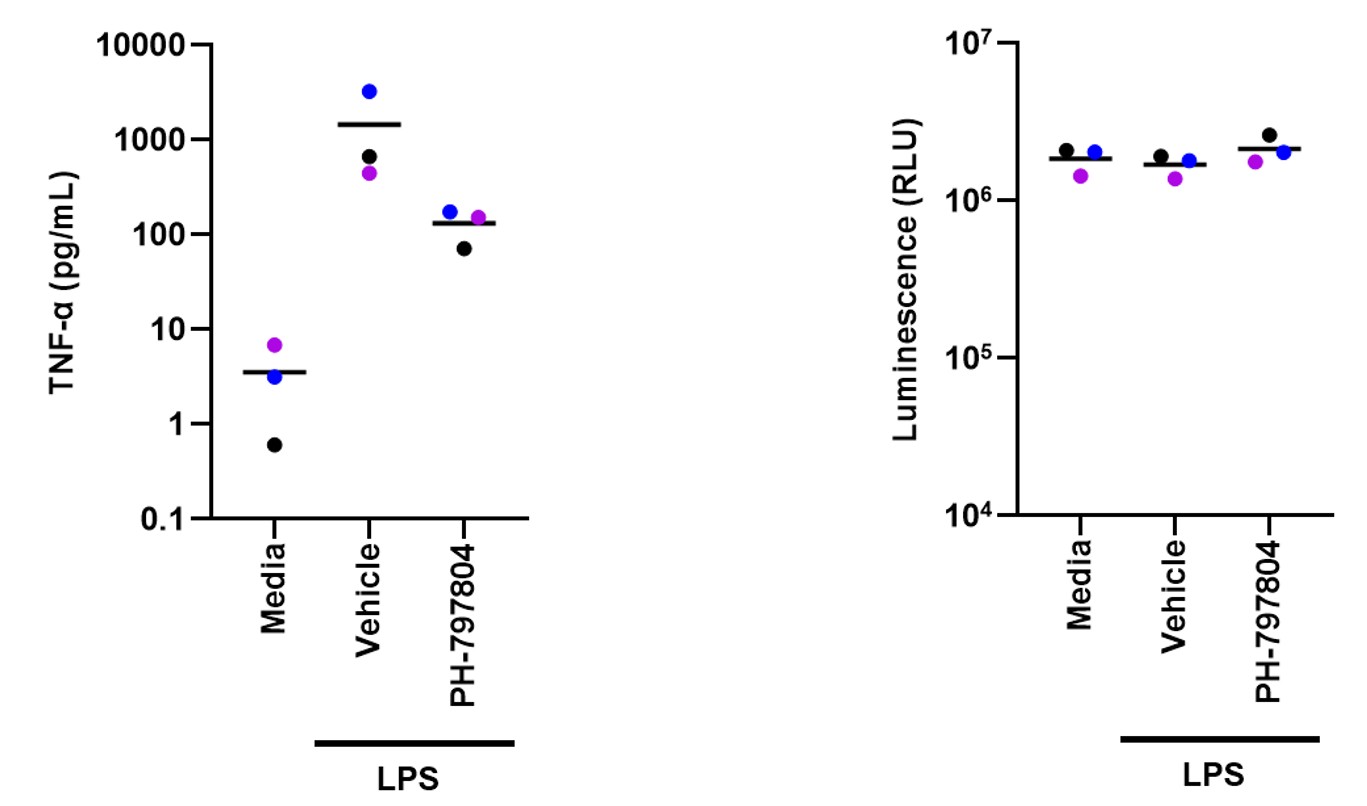
  • Data demonstrate modulation of inflammatory responses (e.g. inhibition of TNF-α production following pathway blockade).
  • PBMC and isolated formats allow comparison of systemic versus monocyte-intrinsic effects.
Monocytes display increased cytokine production and elevated activation marker expression in response to LPS stimulation.
Inhibition of the p38 MAP kinase pathway reduces (A) TNF-α production without adversely affecting (B) cell viability (CellTiter-Glo).

Conclusions

These assays provide a practical approach to characterizing monocyte-driven inflammation and its modulation by therapeutic compounds.

By combining flexible formats with diverse functional readouts, they enable clear differentiation of compound effects on innate immune activation, supporting mechanism-of-action studies and progression of candidates targeting inflammatory pathways.